Sign Up Here – New Tenants
Login Here – Existing Tenants
Sign Up Here – New Landlords
Login Here – Existing Landlords


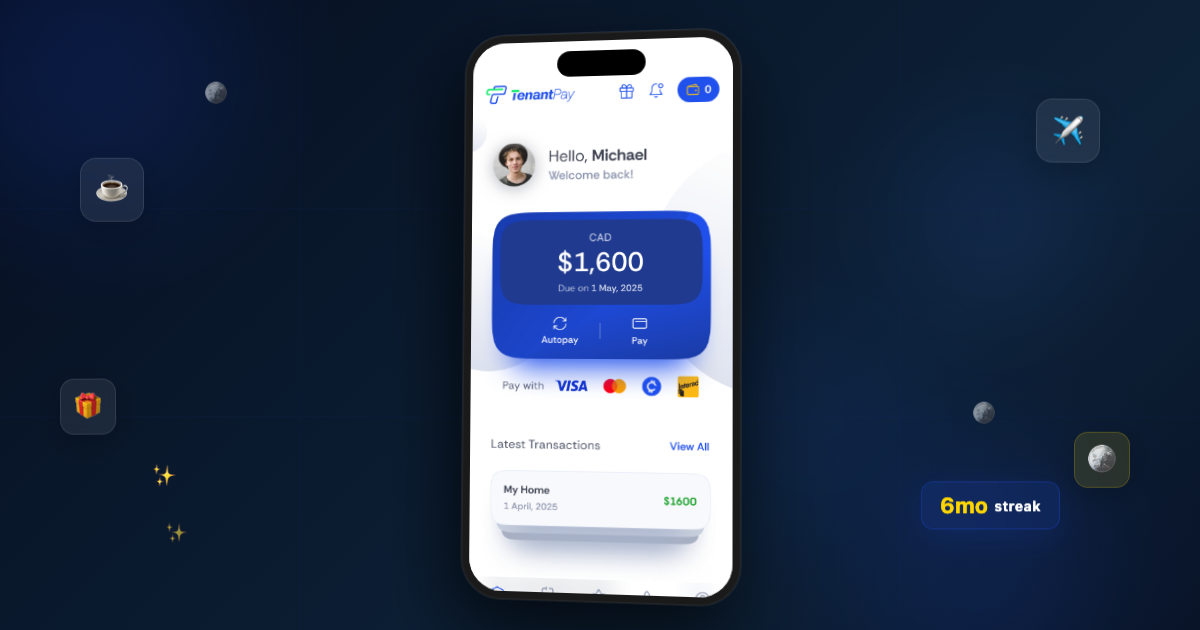
You earned 47 Aeroplan points on your last coffee run. You maintained a 212-day streak on Duolingo. Your credit card sent a push notification celebrating your "milestone spend."
Now think about your rent. You paid $1,800 last month. On time. Like you have for three years. And the financial system handed you back... nothing. No points. No streak. No confetti animation. Just a lighter bank account and a receipt.
The rent rewards gap in Canada is absurd. A $6 latte earns you points at three different loyalty programs. Your largest monthly expense earns you a void. But that gap is closing, and the force closing it is the same one that made you care about a cartoon owl's feelings: gamification.
Rent gamification applies the same psychology that powers loyalty programs, fitness apps, and language-learning streaks to your monthly rent payment. Instead of treating rent as a one-way transaction, a gamified system layers in rewards, milestones, and progress mechanics that make each payment count toward something.
Every time you pay rent, you could be:
This is not theoretical. Rent rewards programs already exist in Canada, and they work on the same behavioural principles that make Starbucks Stars and Aeroplan sticky. If you are already exploring the best ways to pay rent online in Canada, you may be closer to a gamified system than you think.
Rent gamification turns rent payments into a structured reward system with points, streaks, and bonuses, giving renters tangible returns on their largest monthly expense., according to Psychology Today's analysis of what separates effective gamification from exploitative design
Duolingo did not become a $12 billion company because its Spanish lessons are exceptional. It became one because breaking a streak feels like losing something you earned.
This is loss aversion. People feel the pain of losing roughly twice as intensely as the pleasure of gaining. A 90-day on-time rent streak is not just a number. It is 90 days of effort you do not want to reset.
Variable reward schedules make it stickier. Rewards at unpredictable intervals create stronger habits than predictable ones. When a rent platform layers in birthday bonuses, anniversary rewards, and tiered referral milestones on top of monthly points, it creates the same dopamine architecture that keeps you checking your phone.
Here is what the research shows works:
The result: people who were already paying rent on time now feel good about it. And people who were occasionally late now have a reason not to be., according to research by the Ontario Securities Commission on how gamification techniques shape financial behaviour
Gamification is not new to finance. Credit cards have run points programs since the 1980s. Wealthsimple gamified investing with round-ups. Even the CRA made RRSP contributions feel like a game with the tax refund as the reward.
But rent was left out. The traditional system has no infrastructure for it. You write a cheque or set up a bank transfer. Your landlord deposits it. Nobody tracks streaks because nobody built the rails.
That changed when digital rent platforms entered the market. Once rent flows through a platform, every payment becomes a data event. And data events can be gamified.
Three trends converged: alternative credit data became a policy priority (Equifax now accepts rent reporting), open banking made financial data portable, and the permanence of renting. Nearly a third of Canadian households rent, and for many, this is permanent., according to CMHC's 2025 Rental Market Report
A properly gamified rent platform does not just hand you a flat points-per-dollar rate and call it a day. It builds a layered reward ecosystem that mirrors the best consumer loyalty programs.
Here is the anatomy, using TenantPay Points as the reference:
Onboarding rewards hook you immediately. A welcome bonus on signup, a first rent payment bonus when you pay at least $500 — the system starts rewarding before you have built a habit.
Monthly earning is the baseline. Every rent payment earns points. But the interesting layer is the early bird tier system: pay 7 days early and you earn a bonus, 14 days early earns more, 21 days early earns the most. All require autopay, which itself is a retention mechanic.
Streak milestones create long-term engagement. Three months on time. Six months. Twelve months. Each milestone carries increasing rewards and increasing psychological weight — at month 11, you are not missing that payment for anything.
Referral tiers add a social engine. Tell one friend, earn a reward. Three friends hits Viral Tier 1. Six friends, Tier 2. Ten friends, Tier 3. The tiers are cumulative, meaning reaching Tier 3 pays out for every milestone along the way.
Lifestyle touches make it personal. Birthday bonuses. Anniversary rewards. Points for opening the app, completing surveys, activating rent reporting.
Redemption that matters. Points are redeemable at over 115 brands — Air Canada, Starbucks, gift cards across retail and dining. Your rent funded your morning coffee. Your 12-month streak earned progress toward a flight.
Credit building runs in parallel. Rent reporting to Equifax means every payment also builds your credit file. For the one in five Canadians who are credit invisible, this is transformational — see our complete guide to building credit in Canada for the full picture.
The sceptic's take: gamification is manipulation. Skinner boxes with better UX. Fair concern when the behaviour being incentivized is mindless consumption. But rent is different.
You are already paying rent. Gamification is not tricking you into spending money you would not otherwise spend. It is giving you returns on money you are already committed to spending. The nudge is not "pay rent" — it is "pay on time, through a system that makes it count."
The downstream effects matter: on-time habits improve your credit profile, credit building creates access to better rates on cars and mortgages, points redemption returns tangible value on a bill that historically returned nothing. This is gamification applied to a behaviour that is already positive. The system is not manufacturing demand. It is recognizing effort. For a look at the best automated rent apps in Canada, see our 2026 comparison guide.
The rent rewards gap has always been absurd. You are rewarded for a $6 latte, a streaming subscription, a department store purchase. But your largest monthly expense — the one you prioritize above everything else — has been met with silence.
That gap is closing. Gamification brought streaks, milestones, and variable rewards to rent, and platforms like TenantPay built the infrastructure to make it work in Canada. The game is running. The points are real. The only question is whether you are collecting them.
Start earning rewards on rent you are already paying — explore TenantPay Points.
A: Digital rent platforms like TenantPay let you pay rent through their system, earning points on every payment. Points accumulate through monthly payments, on-time streaks, early payment bonuses, and referrals. You redeem them at 115+ brands including Air Canada and Starbucks.
A: Yes. Platforms that report rent payments to Equifax add your on-time payment history to your credit file. For Canadians with thin or no credit files, this can be one of the fastest ways to establish a credit profile.
A: Streaks track consecutive months of on-time rent payments — typically with milestone rewards at 3, 6, and 12 months. They create a psychological commitment to on-time payment and build a documented track record with the credit bureau.
A: No. TenantPay does not require landlord signup. You can start paying rent through the platform and earning points independently.
A: TenantPay Points are redeemable at over 115 brands. Popular options include Air Canada flights, Starbucks, and gift cards across retail, food, and lifestyle categories.